


What is Wooden Tongue Depressor
Wooden Tongue Depressors, also known as tongue blades, are a versatile and essential tool in the medical field. These disposable, single-use instruments are primarily used to examine the throat and mouth, making them indispensable for medical professionals.
Safety: Wooden tongue depressors are generally considered safer to use than plastic alternatives. If a wooden depressor were to break, it would likely splinter into larger and more visible pieces, making it easier to detect and remove. On the other hand, plastic tongue depressors can shatter into smaller, harder-to-notice fragments, potentially posing a choking hazard.
Biodegradable: Wooden tongue depressors are made from natural materials, primarily birchwood. As a result, they are biodegradable and have a lower impact on the environment compared to plastic alternatives.
Non-toxic: Wooden tongue depressors are usually free from harmful chemicals or toxins, which can be a concern with certain plastic materials.
Sturdiness: Birchwood is a strong and durable material, making wooden tongue depressors less likely to bend or break during use. This sturdiness ensures consistent performance and reduces the risk of accidental injury.
Versatility: Apart from medical applications, wooden tongue depressors find uses in arts and crafts, food sampling, and various DIY projects. Their versatility makes them a handy tool in different settings.
-
![Wooden Tongue Blade]() Wooden Tongue Blade●Size:15*1.8 cm. ●Packaging: 100pcs per box ,50 boxes per carton . ●MOQ: 50 cartons . ●Materials:FSC birch wood. ●OEM orders accepted, customized packaging . ●Quality assurance. Our high-quality
Wooden Tongue Blade●Size:15*1.8 cm. ●Packaging: 100pcs per box ,50 boxes per carton . ●MOQ: 50 cartons . ●Materials:FSC birch wood. ●OEM orders accepted, customized packaging . ●Quality assurance. Our high-quality

Why Choose US
Our Factory
We are a modern factory focusing on the production of high-quality wooden tableware, committed to providing environmentally friendly, healthy and fashionable dining experiences to customers around the world. With years of technology accumulation and the spirit of continuous innovation, we have become one of the leaders in the industry.
Our Certificate
We have obtained BRC, FSC, MSDS, GRS, FDA, BSCI certificates, we ensure that every process from the import of raw materials to the loading and transport of products fully comply with international certification standards.We strictly select certified environmentally friendly wood to ensure that the raw materials of our wooden tableware are of excellent quality.
Our Product
Our product line covers a variety of wooden tableware, including but not limited to wooden knives, wooden forks, wooden spoons, and special-shaped wooden products designed for coffee bars, ice cream shops, etc., such as coffee stirring sticks, ice cream spoons, ice scoops, etc. At the same time, we also provide daily necessities such as toothpicks and tongue depressors to meet your needs in different occasions.
After-sales service
We promise that all disposable wooden tableware meets the quality standards. There is a dedicated customer service team to answer customer questions at any time. Our customer service team will confirm the issue and provide an initial solution. We communicate with our customers on a regular basis to collect feedback and continuously optimize our services.
How to Choose the Right Tongue Depressor for Your Needs
Understanding the Sizes of Tongue Depressors
Tongue depressors come in various sizes, designed to cater to different age groups:
● Adult Tongue Depressor: The standard size for adults is 150mm x 18mm x 1.6mm. This size provides adequate surface area and strength to handle the larger oral cavity of adults, ensuring effective use without causing discomfort.
● Children's Tongue Depressor: For children, there are two common sizes:
● 130mm x 16mm x 1.6mm: This size is slightly smaller, making it suitable for younger children with smaller oral cavities.
● 140mm x 17mm x 1.6mm: This variant offers a balance between size and comfort, ideal for older children who may need a slightly larger depressor.
● Infant Tongue Depressor: For infants, the tongue depressor is significantly smaller, typically measuring 114mm x 10mm x 2mm.
Types of Tongue Depressors Based on Edge Design
● Flat Edge: A flat-edge tongue depressor is commonly used in medical practices where precision is key. The flat edge allows for better control and is often preferred in situations where detailed examination or application is necessary.
● Round Edge: Round-edge tongue depressors are designed for comfort. They are less likely to cause irritation or discomfort, making them ideal for children and individuals with sensitive mouths. These are often used in home healthcare settings or by practitioners who prioritize patient comfort.
Sterilization Options
● Sterile Tongue Depressor: These depressors have undergone sterilization to eliminate bacteria and other pathogens. Sterile tongue depressors are essential in medical and surgical settings where infection control is critical. They are individually wrapped to maintain their sterility until use.
● Non-Sterile Tongue Depressor: Non-sterile tongue depressors are more commonly used in non-critical environments, such as educational settings, arts and crafts, or general home use. While they are still manufactured in a hygienic environment, they have not been subjected to the same rigorous sterilization process as their sterile counterparts.
Choose the Tongue Depressor
● Purpose: Determine the primary use of the tongue depressor. For medical or dental examinations, a sterile, flat-edge tongue depressor might be best. For general or non-medical use, a non-sterile, round-edge option could be sufficient.
● Age of the Patient: Choose the size according to the age group of the patient. An adult-sized depressor might be too large for a child or infant, leading to discomfort.
● Comfort and Sensitivity: If the patient has a sensitive mouth or if you are working with children, a round-edge depressor may be the better choice.
● Environment: In a sterile environment, always opt for sterilized tongue depressors to prevent infection.
How To Use The Tongue Depressor
Turn 50% GS 20 ml/branch into the sterile covered stainless steel tweezers every day for use. The liquid and container are replaced twice a day. After use, the container is autoclaved. The tongue depressor is soaked with 500 mg/L chlorine disinfectant for 30 minutes and then incinerated according to medical waste.
When the child needs to use the tongue depressor to see the doctor, open the disposable tongue depressor bag, soak the tongue depressor in a 50% GS sterile solution for 1 min, take out the water without dripping, firstly the tongue depressor Place it on the tip of the child's tongue to let it taste sweet, then let the child open his mouth and quickly press down on the base of the tongue. At this time, the child does not cry or make trouble, and compares with the doctor's various examinations.
In order to distract children's attention, you can hang brighter murals in the clinic, put some toys to attract children's attention, but also make the diagnosis rapid.
Proper use of the tongue depressor can reduce the fear of the child and reduce the dispute between the doctor and the patient. Whether it is for the parents or the medical staff, a good method can reduce a lot of trouble.
Step-by-Step Guide to Using a Sterile Wooden Tongue Depressor
● Hand Hygiene: Before handling the tongue depressor, wash your hands thoroughly or use hand sanitizer to maintain a sterile environment.
● Select a Sterile Depressor: Choose an individually packaged sterile tongue depressor, ensuring it is intact and has not expired.
● Comfort and Reassurance: Explain the procedure to the patient, especially to children, to alleviate any fear. Ask them to sit comfortably, either on an examination table or a chair.
● Proper Lighting: Ensure the examination area is well-lit to facilitate a clear view of the mouth and throat.
● Open the Package: Carefully open the sterile packaging without touching the depressor's surface that will contact the patient's mouth.
● Positioning: Instruct the patient to open their mouth and say "ah," which naturally positions the tongue lower and the mouth wider.
● Depression: Gently place the tip of the depressor on the center of the tongue. Apply light pressure downward and slightly forward to depress the tongue, providing a clear view of the oral cavity and pharynx.
● Examination: Conduct the necessary examination, looking for any abnormalities or signs of infection. Ensure to communicate with the patient throughout the process to keep them at ease.
● Disposal: After the examination, immediately dispose of the used tongue depressor in a designated biohazard container to prevent contamination.
● Hand Hygiene: Clean your hands again to maintain hygiene standards.
The Types of Tongue Depressors
Simple as they may seem, there are a number of options to consider when it comes to purchasing tongue depressors.
Size
The standard wood tongue depressor measures 6 inches in length. However, some manufacturers offer size options for the comfort of the smallest patients. Junior wooden tongue depressors measure 5 ½ inches in length by 5/8 inches wide, while infant wood tongue depressors measure 4 1/5 inches long by 3/8 inches wide.
Sterile or non-sterile
Tongue depressors are typically available in individual sterile pouches or in non-sterile bulk packaging. Medical examinations will dictate the use of a sterile single-use tongue depressor, and disposal according to all relevant biohazard requirements.
Flavor
For younger patients, a trip to the doctor's office can be an uncomfortable or worrisome experience. To ensure these patients' cooperation and comfort, some tongue depressor manufacturers now offer flavored options. Cherry, grape, and strawberry flavored tongue depressors are a small touch that can help set a clinical practice apart.
While tongue depressors are generally safe to use, it is important to take certain precautions to prevent any potential risks. Firstly, always ensure that the tongue depressor is in good condition, free from any splinters, cracks, or sharp edges that could cause injury. Discard any defective tongue depressors immediately.
When using tongue depressors, be cautious to avoid any gagging or choking. Apply gentle pressure on the tongue, gradually moving it downward, while carefully observing the patient's response. If the patient experiences any discomfort or difficulty breathing, the examination should be stopped immediately.
Additionally, it is essential to maintain a sterile environment when using tongue depressors. This includes using disposable tongue depressors whenever possible, using gloves during examinations, and properly disinfecting reusable tongue depressors. These measures help to prevent the spread of infections and ensure the safety of both healthcare professionals and patients.


Patient Age
Considering the patient's age when choosing the right tongue blade is most significant. It helps ensure the patient is comfortable and safe during the oral examination.
Pediatric Patients
Pediatric patients, for example, have smaller mouths and more sensitive gag reflexes than adults and therefore require a different type of depressor.
Typically, for children, tongue depressors are comparatively smaller. However, they come in various shapes, such as butterfly patterns, to make the procedure more comfortable.
Adult Patients
Typically, tongue depressors for adult patients are larger and more rigid to provide a wider view of the oral cavity.
Geriatric Patients
Geriatric patients may require different types of tongue retractors due to age-related changes in the oral cavity. Such patients' tongues may be more fragile and prone to injury.
Also, they may have difficulty in opening their mouths wide enough with a traditional tongue spatula. Therefore, geriatric patients require more flexible tongue blades.
It will need the following machine
1. Tongue depressor wood plate cutting machine
2. Tongue depressor punch cutting machine
3.Tongue depressor drying and polishing machine
4. Tongue depressor ordering machine
5. Tongue depressor chamfering machine
6. Tongue depressor bundling machine
7. Tongue depressor single pieces wrapping machine
To tongue depressor shape-drying and polishing these tongue depressor-chamfering tongue depressor edge-tongue depressor bundling-tongue depressor single piece packing as final product. Saw raw material wood to segment-steam boiling wood segment-rotary cutting to wood plate-punch cutting
1. Cut of wood in the requested measure.
2. Wood conditioning: piece's immersion in water for 6 hours followed by a bath's heating to 110°C for 12 hours and at last a cooling at room temperature for at least 8 hours.
3. Removing of bark from raw piece.
4. Preparation of the sheet at 60°C; minimum thickness 2 mm.
5. Pressing of the piece at 35°C. Attention: blades used for pressing are replaced every hour.
6. Wood's drying process at 130-140°C for 60 minutes in oven.
7. Removing of flashes and rough edges.
8. Sterilization with ethylene oxide (when requested).
9. Packaging and labelling.
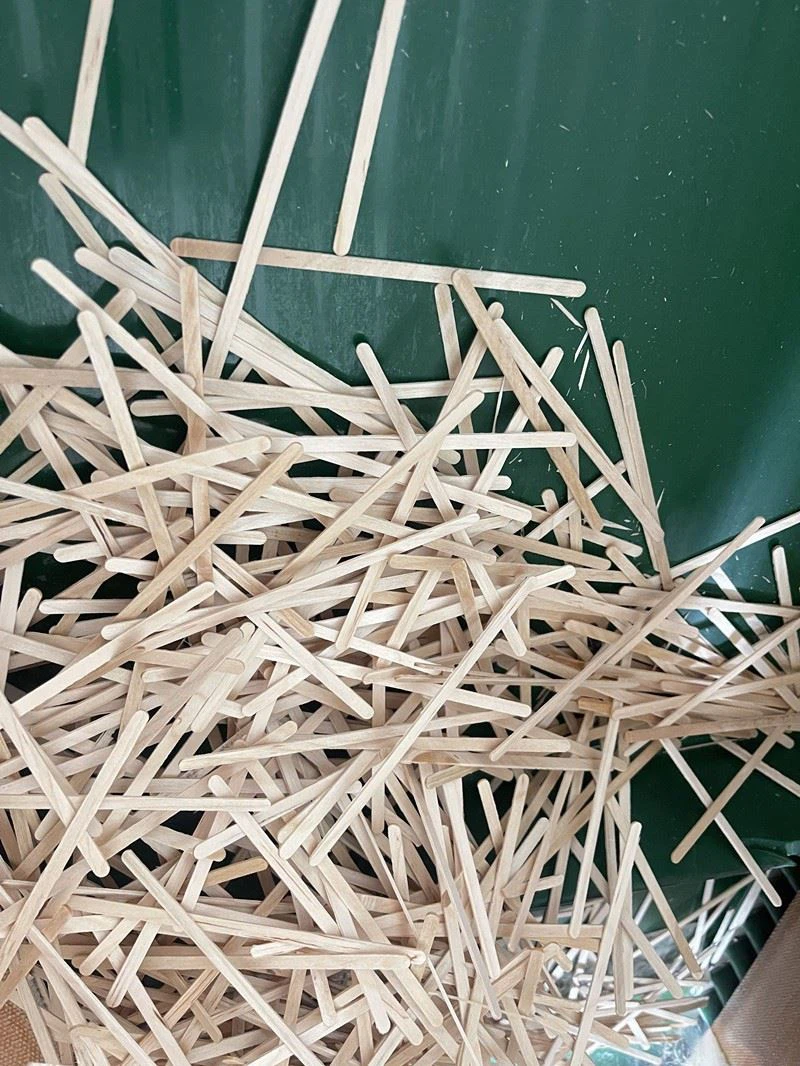
Recommended Sizes of Wooden Tongue Depressor
Traditionally, Wooden Tongue Depressors are made from high-quality birch wood, which is smooth, splinter-free, and biodegradable. This ensures patient comfort and safety during examinations.
Wooden Tongue Depressors are available in different sizes to accommodate various needs, including pediatric and adult patients. The two standard sizes are:
Adult Tongue Depressors: These are typically around 150mm in length, providing ample surface area for thorough examinations.
Pediatric Tongue Depressors: Slightly shorter at around 120mm, these are designed for use on children and patients with smaller mouths.
Selecting the appropriate size ensures effective and comfortable examinations.
Single-Use: Wooden Tongue Depressors are intended for single use only. Discard after use to prevent the risk of cross-contamination.
Splinter-Free: Always inspect depressors for splinters or defects before use. Discard any depressors with visible issues.
Patient Comfort: Handle the depressor with care to minimize discomfort during examinations.
Hygiene: Maintain strict hygiene standards, including handwashing and glove use, when handling patients and tongue depressors.
Application of Tongue Depressor
Hospitals and Clinics
Commonly, disposable tongue depressors are preferable in hospitals and clinics due to their convenient use. Typically, these depressors are made of wood or plastic and can be easily disposable after use, which helps to prevent the spread of infection.
In-home Healthcare Settings
In contrast, reusable tongue elevators may be more practical and cost-effective for in-home healthcare settings. These can be made of metal or silicone and are sterilizable for multiple uses.
Waxing Spatula
A popular choice for beauty professionals, these depressors are perfect for precise wax application, ensuring smooth and even coverage.
While tongue depressors are primarily used in the medical field, they also have creative applications beyond healthcare settings. These versatile sticks can be utilized in various DIY crafts and projects. From building small structures to creating picture frames or even as a tool for spreading glue, the possibilities are endless.
Tongue depressors are readily available, affordable, and easy to work with, making them an ideal material for craft enthusiasts. They can be painted, glued together, or even carved to create unique and personalized items. Exploring creative uses for tongue depressors not only provides a fun and engaging activity but also promotes resourcefulness and imagination.
FAQ
Heze Jiaxun Wood Industry Co., Ltd. is one of the most professional wooden tongue depressor manufacturers and suppliers in China, specialized in providing high quality customized service and OEM&ODM service. Our products are sold year-round to Australia, Europe, Southeast Asia, Africa and South America. We warmly welcome you to wholesale bulk durable wooden tongue depressor in stock here and get free sample from our factory.
Popular Products


