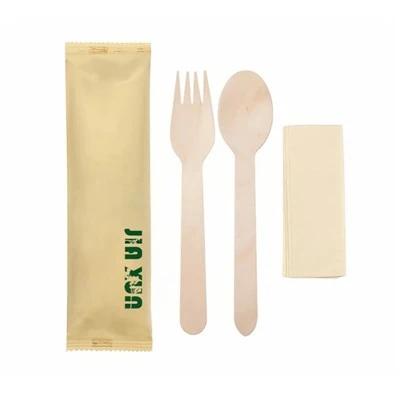
For foodservice chains and European or North American importers, hot stamping vs ink printing on wooden utensil handles comes down to one decisive factor: eliminating chemical transfer risk before goods reach customs. Ink-free thermal hot stamping uses heated metal dies to press a permanent brand mark directly into kiln-dried birch wood with zero pigments, solvents, or binders, making FDA, LFGB, and EU 1935/2004 clearance significantly simpler than ink-printed alternatives. While direct handle hot stamping carries a 1×20GP container MOQ to justify automated die setup, buyers seeking smaller trial runs can still achieve full brand visibility through 1 to 2 color printed paper pouches starting at 500 cartons.
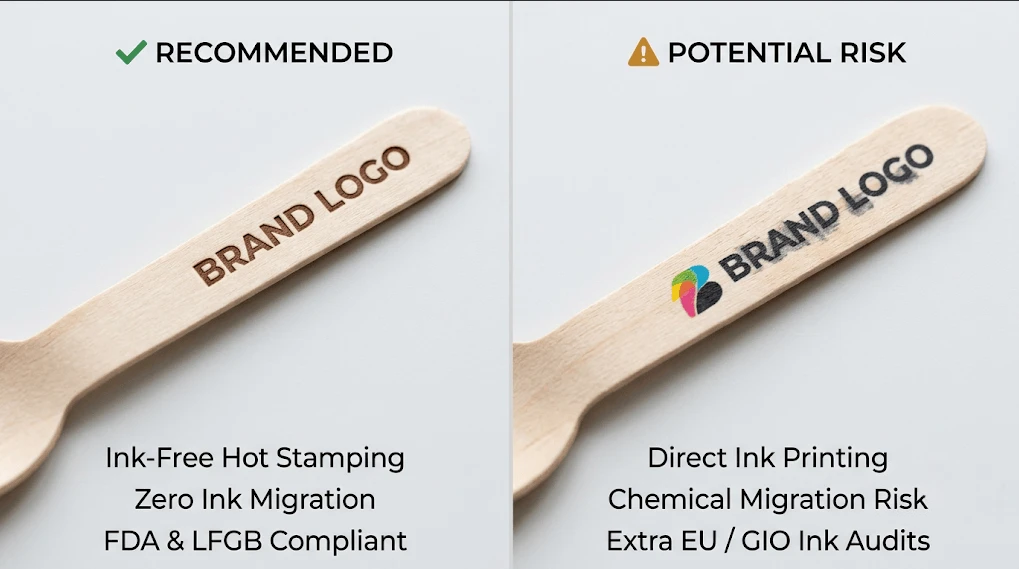
Why Porous Wood Complicates Chemical Migration in Printed Cutlery
Applying liquid ink directly onto untreated disposable birch utensils creates an avoidable compliance vulnerability that does not exist on non-porous plastics or stainless steel. Because natural white birch retains microscopic open-grain pores even after steam degreasing and 4-stage dry tumbling, solvents, photoinitiators, and pigment binders can wick below the surface and leach back out when exposed to hot soup, acidic dressings, or greasy takeout meals.
Procurement teams evaluating custom branded wooden cutlery kits face a straightforward regulatory reality: every added chemical layer requires separate toxicological validation. Under Regulation (EC) No 1935/2004, any food-contact article must not transfer constituents into food in quantities that endanger human health or alter taste and odor. Even when a logo sits on the handle rather than the bowl of a spoon, regulators treat the entire utensil as a direct food-contact article because handles routinely slip into bowls, rest inside warm meal boxes, or touch wet fingers during use.
Choosing ink-free logo branding for food contact wood removes that entire testing variable at the source. Instead of depositing foreign substances onto the wood, a precision-machined heated die compresses and lightly darkens the surface fibers to a controlled depth. Nothing is added to the birch substrate, which keeps the utensil 100% wood from tip to handle and removes chemical migration in printed cutlery from your QA audit sheet. If your brand is finalizing packaging specs for Q1–Q2 tenders, switching from handle ink to thermal debossing is the fastest way to cut lab-testing lead time.
Technical & Compliance Comparison: Hot Stamping vs Ink Printing
When procurement and quality teams compare hot stamping vs ink printing on wooden utensil handles, the gap widens once laboratory testing, temperature exposure, and end-of-life compostability are priced into total landed cost. The table below summarizes the operational and regulatory differences buyers need to evaluate before approving artwork.
|
Evaluation Criteria |
Ink-Free Hot Stamping (Thermal Debossing) |
Direct Ink / Pad Printing on Wood |
|
Added Chemicals |
Zero inks, solvents, photoinitiators, or varnishes |
Pigments, binders, curing agents, and solvents |
|
Chemical Migration Risk |
None (100% pure Grade-A birch substrate) |
Moderate to high on porous wood under heat, oil, or acid |
|
US FDA 21 CFR & LFGB Audits |
Standard wood testing only (PCP Not Detected, sensory) |
Requires additional ink positive-list & specific migration tests |
|
EU & German GIO (Jan 2027) Readiness |
Naturally exempt from printing-ink positive-list restrictions |
Must prove finished-article compliance under German GIO |
|
Durability in Hot or Oily Food |
Permanent physical indentation; cannot rub off or smear |
Can bleed, soften, or transfer onto wet hands and warm food |
|
Laser Engraving Alternative? |
Not used on disposable utensils (avoids soot, char odor, and high unit cost) |
Not applicable |
|
Visual Aesthetic |
Tactile, natural brown tone aligned with plastic-free positioning |
Multi-color possible, but looks coated and weakens eco perception |
|
Production MOQ |
1 × 20GP container for direct handle hot stamping |
Varies, but often carries added ink-setup and lab-retest fees |
|
Alternative Low-MOQ Branding |
500 cartons for 1 to 2 color printed paper pouches |
Not required if already printing externally on paper wraps |
One technical nuance buyers often ask about is laser engraving. For high-volume disposable wooden utensils, we strictly run automated ink-free hot stamping rather than laser engraving. Laser beams burn wood fibers unevenly at high line speeds, leaving surface carbon dust and a smoky smell that can fail DIN 10955 sensory evaluations. Controlled thermal hot stamping compresses the birch grain cleanly without loose soot, keeping both sensory neutrality and unit economics intact for container-scale programs.
2026–2027 Regulatory Audits: FDA 21 CFR, LFGB, EU 1935/2004, and EUDR
Tightening food-contact and deforestation rules across Europe and North America are making printed handles harder and more expensive to clear at border inspection. Buyers specifying ink-free logo branding for food contact wood should verify four regulatory pillars in their pre-shipment compliance packet:
- German Printing Ink Ordinance (21st Amendment to the Consumer Goods Ordinance / GIO): According to the German Federal Institute for Risk Assessment (BfR), the transition period for non-compliant printed food-contact articles runs through December 31, 2026. Starting January 1, 2027, importers must demonstrate finished-article compliance against Annex 14 positive lists and a strict 10 ppb (0.01 mg/kg) non-detect migration threshold for permitted unlisted non-CMR substances in non-direct contact. Hot-stamped birch handles bypass this ink compliance burden completely.
- EU Framework Regulation (EC) No 1935/2004 & German LFGB § 30/31: Both Regulation (EC) No 1935/2004 and German LFGB § 30 and § 31 prohibit food-contact materials from transferring harmful substances or altering food odor and flavor. Similarly, European benchmarks like the Swiss Ordinance SR 817.023.21 enforce strict Annex 10 positive lists for printing inks. Eliminating ink on the utensil keeps your Declaration of Compliance (DoC) focused strictly on natural birch wood.
- US FDA 21 CFR Wood Safety: Under 21 CFR 178.3800, food-contact wood articles must remain free of unauthorized chemical preservatives. Every export lot should carry verified third-party lab reports confirming PCP (Pentachlorophenol) Not Detected alongside BRCGS Packaging Materials hygiene certification (BRCGS Grade B, Site Code 10009096).
- EUDR & Forest Chain-of-Custody Traceability: Under Regulation (EU) 2023/1115 (EUDR), wooden tableware classified under HS 4419 requires verifiable deforestation-free Due Diligence Statements (DDS) and geolocation traceability. Buyers should confirm active FSC-C189530 certification paired with third-party EUDR Due Diligence verification (SGS EUDR Certificate CN26/00000645, valid through January 2031 for HS 4419 wooden tableware).
Requesting these certificate numbers before issuing a purchase order protects your import broker from port holds and unexpected lab re-testing charges.
MOQ : Balancing 1×20GP Handle Stamping and 500-Carton Printed Pouches
Direct handle hot stamping requires a 1 × 20GP container MOQ because automated inline branding demands custom brass or steel die machining, heated-roller temperature calibration across high-speed feeders, and dedicated production-line changeover. Running smaller batches on 20 automated production lines creates excessive downtime and raises the per-piece stamping cost beyond what foodservice distributors can absorb.
However, mid-sized QSR brands, regional catering groups, and seasonal retail programs do not need to wait until they reach full-container volume to launch branded tableware. Procurement teams can match their branding method to their order volume using three practical tiers:
- Full-Container Handle Hot Stamping (MOQ: 1 × 20GP): Best for national restaurant chains, airline caterers, and supermarket private labels locking in annual programs. Delivers permanent, zero-ink brand exposure on every fork, knife, and spoon with a standard 25 to 35 day bulk container lead time.
- Custom Printed Paper Pouches & Meal Kits (MOQ: 500 Cartons): Standard cutlery sets (500 sets per carton, including 160mm 3-in-1 to 6-in-1 kits with napkin and condiments) and 1 to 2 color custom printed paper pouches start at 500 cartons (500,000 pcs for individual wraps). Because the ink sits exclusively on the exterior of the paper wrap, there is zero direct food contact on the utensil itself.
- EU-Compliant Paper Wrapping Specifications: For European shipments, avoid plastic film wraps that trigger single-use plastic bans or greenwashing audits. Choose either 100% plastic-free kraft or white paper pouches for strict zero-plastic municipal tenders, or PE-lined kraft/white paper pouches where heat-seal moisture protection is needed (reported under standard national EPR schemes and never mislabeled as plastic-free).
Splitting your branding strategy by putting bold multi-color graphics on an exterior paper pouch (500-carton MOQ) while keeping the inner birch utensil clean or hot-stamped (1×20GP MOQ) gives you both regulatory safety and lower inventory risk.
Buyer QC Checklist for Hot-Stamped Birch Utensils
Consistent hot-stamping quality depends on tight upstream wood-processing controls rather than the stamping die alone. Across a 6,000 m² facility operating since 2006 (19 years of production experience) with 20 automated production lines and a monthly capacity exceeding 200 million units, repeatable export quality comes down to measurable parameters you can verify during pre-shipment inspection:
- Kiln-Dried Moisture Window (8%–10%): Always test incoming and pre-shipment cartons with a calibrated pin moisture meter. Wood above 12% moisture causes fuzzy, uneven hot-stamp impressions and risks mold during 30 to 45 day ocean transit; wood below 7% becomes brittle and prone to cracking under die pressure. Maintaining 8%–10% moisture also preserves a 24-month warehouse shelf life.
- Artwork & Line-Weight Discipline: Vector logos for thermal debossing should use minimum line widths of 0.3mm to 0.4mm and avoid dense solid ink blocks. Overly intricate typography traps heat and blurs along the birch wood grain.
- Surface Finish & Splinter Check: Confirm that Grade-A Latvian white birch blanks undergo steam degreasing and 4-stage dry tumbling before stamping. Run a tactile wipe check across the stamped handle edges to confirm zero raised fibers, zero soot rub-off, and no burnt odor.
- Operating Temperature Disclosure: Verify that inner cartons and spec sheets note the safe operating range of natural birch cutlery (-4°C to 60°C) and advise against prolonged submersion in boiling liquids to prevent warping.
- Pre-Shipment Document Bundle: Before releasing balance payment, confirm your shipping dossier includes the FSC-C189530 claim on the commercial invoice, EUDR DDS reference data (CN26/00000645), BRCGS Grade B certificate copy (Site Code 10009096), and current FDA 21 CFR / LFGB lab reports.
FAQ
Q: Why is hot stamping preferred over ink printing on wooden utensil handles for EU and US buyers?
A: Ink-free hot stamping adds zero pigments, solvents, or binders to porous birch wood, eliminating chemical migration in printed cutlery. This simplifies compliance with US FDA 21 CFR, German LFGB § 30/31, EU Regulation (EC) No 1935/2004, and the German Printing Ink Ordinance taking full effect on January 1, 2027.
Q: Do you offer laser engraving instead of hot stamping for custom logos on wooden cutlery?
A: No. For disposable birch utensils, we exclusively use automated ink-free hot stamping rather than laser engraving. Thermal die stamping produces a clean, uniform impression at high production speeds without the loose carbon soot, smoky odor, or higher unit costs associated with laser burning.
Q: What is the minimum order quantity for hot-stamped wooden cutlery vs. custom printed paper wraps?
A: Direct handle hot stamping requires an MOQ of 1 × 20GP container to cover dedicated metal die tooling and automated line setup. If you need a lower entry volume, standard wooden cutlery kits and 1 to 2 color custom printed paper pouches both start at 500 cartons.
Q: Will a hot-stamped logo fade or bleed when used with hot soup or greasy takeout food?
A: No. Because thermal debossing physically compresses and darkens the birch wood fibers rather than coating the surface with ink, the logo cannot smudge, peel, or bleed onto hands or food during normal use (-4°C to 60°C).
Q: Which compliance documents should accompany a shipment of custom branded wooden cutlery to Europe?
A: EU buyers should request a Declaration of Compliance referencing Regulation (EC) No 1935/2004 and LFGB § 30/31, third-party migration and sensory reports, FSC-C189530 chain-of-custody documentation, BRCGS Packaging Materials Grade B certification, and EUDR Due Diligence traceability records covering HS 4419.
Next Steps: Samples, Compliance Dossier, and Quote Request
If you are evaluating ink-free logo branding for food contact wood for upcoming 2026–2027 foodservice tenders, testing physical samples in your own menu items is the most reliable way to verify impression clarity and handle feel. Review our full specification range for custom branded wooden cutlery kits to compare 140mm to 205mm birch formats, 500-carton printed paper pouch sets, and 1×20GP hot-stamped programs.
- Request Physical Samples (5–7 Days): Email your vector logo (AI or PDF) and target utensil length to info@jiaxunwood.com or message WhatsApp +86 15154221612 to check die feasibility and request sample kits.
- Download the Compliance Dossier: Ask our export team for the current FDA 21 CFR (PCP Not Detected), LFGB, BRCGS Grade B (Site Code 10009096), FSC-C189530, and SGS EUDR (CN26/00000645) verification packet.
- Get a Container or 500-Carton Quote: Share your destination port, wrapping preference (100% plastic-free paper or PE-lined paper), and estimated volume for a landed-cost breakdown.