

Selecting between 160mm and 185mm wooden cutlery comes down to container depth and food density: 160mm (1.6mm–1.8mm thick) handles standard takeout bowls, salads, and pasta without excess shipping volume, while 185mm/186mm (up to 2.0mm thick) prevents handle flex and hand mess on deep soup containers, grilled steaks, and plated catering entrees. Ordering the wrong tier either drives up freight costs on light meals or triggers tine snapping and customer complaints on dense proteins. For foodservice buyers sourcing pre-packed disposable wooden cutlery kits, aligning utensil length, birch thickness, and carton specs to each menu category is the fastest way to cut breakage claims.
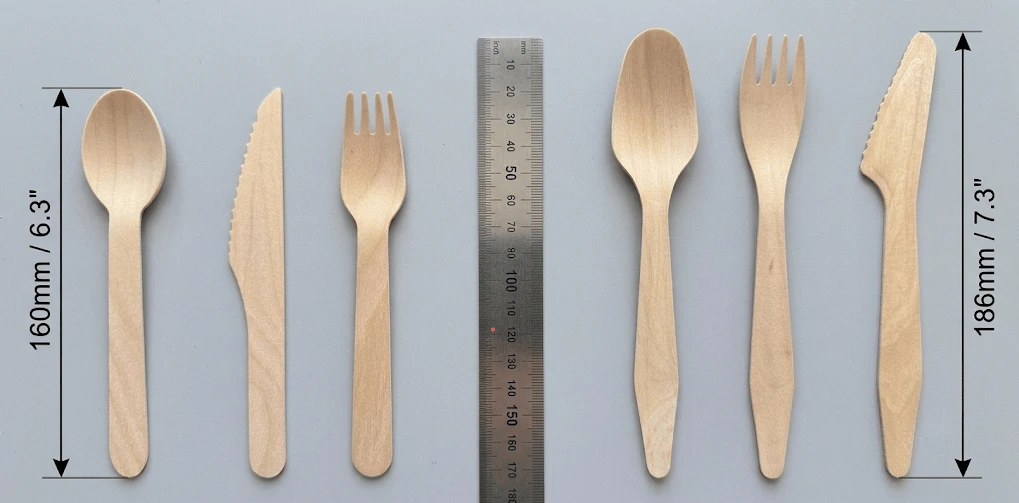
Quick Spec Matrix: 160mm vs. 185mm/186mm Sizing Standards
Understanding disposable utensil length for takeout meals starts with separating standard delivery kits from heavy-duty entree silverware. While 140mm utensils are strictly reserved for side desserts, ice cream cups, and coffee service, commercial foodservice procurement centers on the 160mm and 185mm/186mm tiers.
|
Specification |
160mm Standard Takeout Tier |
185mm / 186mm Heavy-Duty Tier |
|
Catalog Length |
160mm (6.3 in) |
185mm / 186mm (7.3 in) |
|
Blade / Neck Thickness |
1.6mm – 1.8mm |
1.8mm – 2.0mm |
|
Ideal Container Depth |
Shallow to medium clamshells & bowls (< 65mm) |
Deep soup tubs, tall noodle boxes & dinner plates |
|
Primary Menu Fit |
Cold salads, grain bowls, pasta, rice dishes |
Grilled steak, bone-in chicken, stews, catering |
|
Primary Packing Format |
Pre-packed 3-in-1 to 6-in-1 kits (ST-IPK*160) |
Bulk 5,000 pcs/ctn (ST-W*186) or 4-in-1 / 6-in-1 sets |
|
Freight Efficiency |
Compact carton footprint; lower CBM per 1,000 sets |
Higher wood mass per piece; built for structural load |
Procurement Note: If your distribution mix covers QSR delivery and cafe chains, 160mm kits cover roughly 75%–80% of daily meal orders. Reserve 185mm/186mm SKUs for steakhouses, hotel banquets, and premium meal-kit brands where diners expect full-size cutlery feel.
Menu-to-Utensil Matching: Salads, Pasta, and Steak
Matching utensil geometry to actual dish resistance eliminates mid-meal snapping and keeps packaging costs predictable.
- Cold Salads, Poke & Grain Bowls → 160mm Fork + Napkin or 3-in-1 Kit (1.6mm)
Leafy greens, quinoa, and diced proteins require minimal cutting torque. A 160mm birch fork provides sufficient reach for standard 500ml–1,000ml salad bowls without protruding awkwardly from narrow takeaway bags. Upgrading to 185mm for cold salads adds unnecessary carton weight and shipping CBM without improving user experience.
- Hot Pasta, Ramen & Saucy Noodles → 160mm–165mm Fork/Spoon (1.6mm–1.8mm) or 186mm for Deep Tubs
Twirling fettuccine or spaghetti creates lateral stress at the fork neck, especially when sauces exceed 50°C. Unlike standard PLA bio-plastic-which softens above 50°C-kiln-dried birch maintains rigidity in hot pasta dishes. Use 160mm for wide, shallow pasta boxes; step up to the 186mm ST-WF186 fork or ST-WS186 spoon when serving tall 32oz soup or broth containers so knuckles stay clear of the rim.
- Grilled Steak, Pork Chops & Dense Cuts → 185mm/186mm Knife & Fork (1.8mm–2.0mm)
Slicing fibrous meats applies concentrated downward pressure on the knife handle and tine tips. Standard 160mm / 1.6mm knives lack the leverage and blade rigidity needed for thick cuts, often causing diners to press directly on the neck until it splinters. Moving to 2.0mm heavy-duty birch in the 185mm/186mm range distributes shear force across a wider cross-section and delivers clean serration bite.
Birch Thickness & Thermal Limits: 1.6mm vs. 2.0mm
Evaluating birch cutlery thickness 1.6mm vs 2.0mm is not just about feel-it directly governs moisture absorption rate, break resistance, and surface finish.
- Raw Material & Mechanical Polishing: Grade-A Latvian white birch offers tight, uniform grain density without chemical bleaches, glues, or plastic coatings. After steam degreasing, pieces undergo multi-stage dry tumbling to remove edge burrs and prevent mouth splinters.
- Load Tolerance: Increasing thickness from 1.6mm to 2.0mm substantially boosts bending resistance at the weakest stress point (the transition between the handle and the fork tines or knife blade).
- Operating Temperature Guardrail: Natural birch cutlery performs reliably across -4°C to 60°C for normal dining and hot takeout transit. However, buyers should advise end-users not to leave wooden utensils submerged in boiling soups or liquids above 60°C for prolonged periods, as extended saturation causes natural wood fibers to swell and warp.
Carton Packing Specs, Container Loading & Custom MOQs
Accurate carton dimensions and pallet planning prevent warehouse bottlenecks and unexpected LCL/FCL freight surcharges. Below are the verified packing specifications for both 160mm pre-packed sets and 186mm bulk single utensils:
Pre-Packed 160mm Cutlery Kit Series (500 Sets / Carton)
|
SKU Code |
Kit Contents |
Sets / Ctn |
Carton Size (cm) |
Gross Weight (kg) |
|
ST-IPKF3160 |
Knife, Fork + Napkin (3-in-1) |
500 |
45 × 22.5 × 35 |
4.6 |
|
ST-IPFS3160 |
Fork, Spoon + Napkin (3-in-1) |
500 |
45 × 22.5 × 35 |
4.7 |
|
ST-IPKFS4160 |
Knife, Fork, Spoon + Napkin (4-in-1) |
500 |
47 × 22.5 × 42 |
6.0 |
|
ST-IPKFS5160 |
Knife, Fork + Napkin, Salt, Pepper (5-in-1) |
500 |
47 × 22.5 × 42 |
5.0 |
|
ST-IPKFS6160 |
Knife, Fork, Spoon + Napkin, Salt, Pepper (6-in-1) |
500 |
47 × 22.5 × 42 |
6.9 |
Heavy-Duty 186mm Bulk Cutlery Series (5,000 Pcs / Carton)
|
SKU Code |
Utensil Type & Length |
Packing / Ctn |
Carton Size (cm) |
Gross Weight (kg) |
|
ST-WK186 |
186mm Wooden Knife |
100 pcs/bag × 50 bags |
49 × 20 × 42 |
12.0 |
|
ST-WF186 |
186mm Wooden Fork |
100 pcs/bag × 50 bags |
58 × 20.5 × 42.5 |
11.5 |
|
ST-WS186 |
186mm Wooden Spoon |
100 pcs/bag × 50 bags |
68 × 21.5 × 42 |
15.1 |
MOQ & Customization Rules for B2B Orders
- Standard Unbranded Bulk Cutlery: 300 cartons (5,000 pcs/carton).
- Pre-Packed Cutlery Kits: 500 cartons (500 sets/carton).
- Custom Printed Paper Wrappers (1–2 Colors): 500 cartons MOQ. For EU Single-Use Plastics Directive (SUP) compliance, specify unbleached kraft paper, white paper wrappers, or SUP-compliant bio-film-avoid conventional plastic sleeves on European eco-tenders.
- Custom Handle Branding: Ink-free high-temperature hot stamping only (no laser engraving on disposable utensils). Because hot stamping requires dedicated automated line tooling, the MOQ is 1 × 20GP container.
Pre-Shipment QC Checklist: Moisture, EUDR DDS & Compliance
Before releasing container balances on bulk wooden tableware, procurement and QA teams should verify five non-negotiable inspection points:
- 8%–10% Kiln-Dried Moisture Content: Verify with a calibrated pin/pinless moisture meter during pre-shipment inspection (PSI). Keeping moisture strictly within 8%–10% prevents mold growth and warping during 30–45 day ocean transit, supporting a 24-month shelf life.
- 5-Ply Corrugated Master Cartons: Confirm cartons meet burst-strength specs and include moisture-barrier inner liners (plus plastic pallets upon request for automated warehouse racking).
- EUDR Geolocation Traceability: For EU imports, request the SGS EUDR Due Diligence Statement (DDS) reference (e.g., CN26/00000645) with GPS harvest polygon data.
- Forest & Food-Safety Certifications: Confirm active FSC-CoC (FSC-C189530), BRCGS Packaging Materials Grade B (Site Code 10009096), US FDA 21 CFR (PCP Not Detected), and LFGB test reports.
- Production Consistency: Verify that your supplier operates dedicated automated sorting and polishing lines (e.g., Jiaxun's 20 automated lines established since 1994) with AQL sampling for splinter-free edges and wrapper heat-seal integrity.
FAQ
Q1: Which wooden cutlery length is better for standard takeout salads and pasta?
A: 160mm (1.6mm–1.8mm thick) is the optimal standard for takeout salads, grain bowls, and shallow pasta boxes. It provides enough reach without increasing carton volume or per-order packaging costs.
Q2: When should buyers upgrade from 160mm to 185mm/186mm heavy-duty wooden cutlery?
A: Upgrade to 185mm/186mm (up to 2.0mm thick) for grilled steaks, fibrous meats, dine-in catering, and deep soup or noodle containers where extra handle leverage and knuckle clearance are required.
Q3: Can wooden cutlery warp in hot soups or takeaway meals?
A: Kiln-dried birch handles normal hot food temperatures from -4°C to 60°C without softening like standard PLA. However, utensils should not be left submerged in boiling liquids above 60°C for prolonged periods, as extended soaking causes wood fibers to warp.
Q4: What are the MOQs for custom logo handle branding and printed wrappers?
A: Ink-free handle hot stamping (we do not offer laser engraving) requires a minimum order of 1 × 20GP container. Custom 1–2 color printed paper wrappers and standard pre-packed cutlery kits have an MOQ of 500 cartons (500 sets/carton).
Q5: How do you prevent mold during ocean freight and meet EU import rules?
A: Every batch is kiln-dried to an 8%–10% moisture content and packed in 5-ply master cartons. Orders ship with FSC-C189530 certification, BRCGS Grade B (10009096) hygiene compliance, and EUDR DDS geolocation traceability (CN26/00000645), paired with paper or SUP-compliant bio-film wrappers.
Request Sizing Samples, Carton Quotes & Compliance Docs
Need to test 160mm vs. 185mm/186mm rigidity with your actual takeout containers? Explore our full range of pre-packed disposable wooden cutlery kits or contact our team (info@jiaxunwood.com / WhatsApp +86 15154221612) to request free stock sample kits, download the full SKU dimension catalog, or get a container-load FOB/CIF quote.


