

Supermarket and big-box retail buyers face steep distribution center (DC) chargebacks when eco tableware cartons fail automated sorting, tear unevenly on the aisle, or miss minimum GS1 General Specifications scan grades. Meeting shelf-ready packaging SRP requirements for eco tableware comes down to engineering three measurable checkpoints before production: ECR-compliant tear-away or window-box structures, ISO/IEC 15416 Grade C (1.5) or higher barcode print verification, and plastic-free or EPR-compliant materials backed by EUDR geolocation traceability. Sourcing pre-tested retail-ready wooden cutlery sets eliminates manual store-level restocking labor and protects retail margins from avoidable compliance rejections.
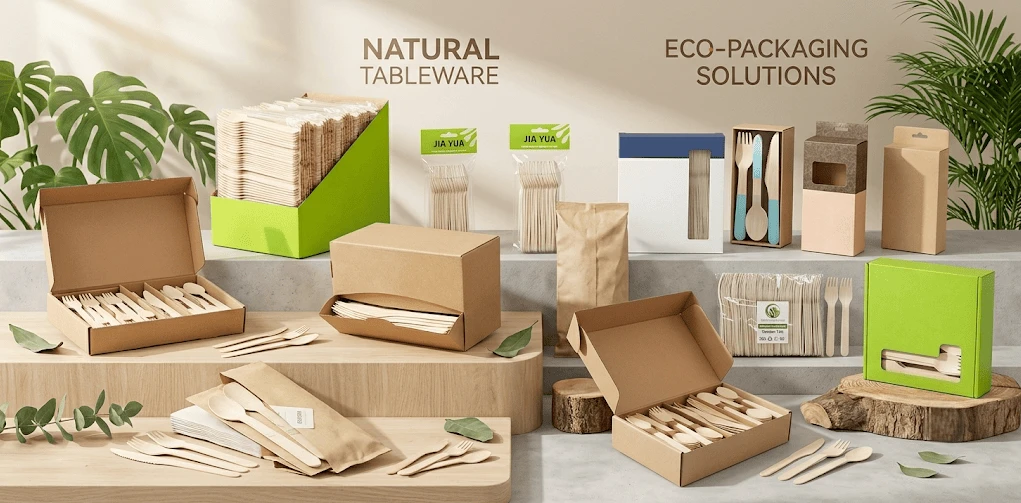
The "Five Easies" of Shelf-Ready Packaging (SRP) for Wooden Tableware
Retailers across North America and Europe evaluate secondary cartons using the FEFCO Shelf Ready Packaging "Five Easies" framework-Easy to Identify, Easy to Open, Easy to Stock, Easy to Shop, and Easy to Dispose. For wooden knives, forks, spoons, and multi-piece kits, poorly engineered perforations are the leading cause of transit collapse and aisle-stocking delays.
When cartons travel 30–45 days by ocean freight, ambient humidity and pallet stacking pressure test corrugated tear-strips. If perforation cuts are too deep, the display tray bursts inside the container; if they are too shallow, store clerks must use box cutters, damaging the inner retail packs and slowing replenishment. Standardizing on 5-ply corrugated outer trays with clean-tear perforations allows associates to pop off the hood in one motion and slide the tray directly onto a standard 22-inch (558 mm) retail shelf without touching individual units. Before approving any SRP dieline, buyers should require a compression-and-tear drop test on filled cartons rather than inspecting flat, empty board samples.
Retail Packaging Formats: Tear-Away Trays, Window Boxes & Hang-Tab Packs
Selecting the right retail window box packaging for wooden utensils or SRP tray depends on whether the SKU sits on a standard gondola shelf, hangs on a seasonal BBQ/picnic pegboard, or dispenses in a bulk cash-and-carry aisle. Because store fixture depths vary by retailer, master carton dimensions and case-pack counts for retail SRP boxes are engineered to each buyer's planogram rather than forced into one fixed template.
|
Packaging Format |
Structural Feature & Shelf Placement |
Material & Regional Compliance Fit |
Branding & Customization MOQ |
Best Retail Channel |
|
Angled-Cut SRP Display Tray |
Open-front corrugated tray with high back wall; holds upright utensil packs for single-step restocking |
Recyclable corrugated board; zero plastic inserts |
Custom flexo/offset tray print; quoted per dieline |
Supermarkets, club stores, picnic/BBQ endcaps |
|
Perforated Dispenser Box |
Enclosed kraft box with front-bottom tear-out window for pull-and-grab dispensing |
Unbleached kraft board; 100% recyclable |
Custom 1–2 color or full CMYK print; 500 cartons for standard sets |
Cash-and-carry wholesalers, office supply, pantry aisles |
|
Die-Cut Retail Window Box |
Paperboard box (vertical side window, top cutout, or lower horizontal window) showcasing birch grain |
Paperboard with open cutout (plastic-free) or compliant bio-film window |
Custom CMYK box + optional ink-free handle hot stamping (1×20GP) |
Eco-grocery chains, organic supermarkets, specialty retail |
|
Flip-Top / Clamshell Compartment Box |
Hinged paperboard retail box with internal dividers separating forks, knives, and spoons |
Kraft or white paperboard; plastic-free structure |
Custom lid & divider print; 500 cartons (500 sets/ctn baseline) |
Entertaining, party-ware aisles, department stores |
|
Euro-Slot Hang-Tab Paper Box |
Enclosed kraft box with integrated top hang-hole for vertical pegboard hooks |
Unbleached kraft paperboard; zero plastic film |
Custom label or direct box print; quoted per SKU |
Hardware/BBQ racks, convenience stores, seasonal clips |
|
Individual Paper Pouch / Sleeve |
Sealed kraft or white paper bag holding 3-in-1 to 6-in-1 utensil + napkin kits |
100% plastic-free paper or moisture-resistant PE-lined paper (EU EPR reportable) |
1–2 color custom printed paper bag: 500 cartons (500,000 pcs) |
Grab-and-go delis, meal-kit add-ons, airline/travel retail |
|
Header-Card & Sticker Polybag |
Clear bag with top hang-hole header card or adhesive barcode label for 50–100 ct bulk packs |
Transparent OPP/PET or compliant bio-film (avoid OPP/PET for strict EU plastic-free tenders) |
Custom printed header card or adhesive label |
Discount chains, non-SUP markets, value bulk aisles |
(Note: Standard unbranded bulk cartons-such as 185 mm birch cutlery at 5,000 pcs/carton or 160 mm 3-in-1 to 6-in-1 sets at 500 sets/carton-can also be configured into custom retail-ready inner boxes upon planogram confirmation.)
GS1 Barcode Labeling & ISO/IEC 15416 Scan-Rate Compliance
Incorrect GS1 barcode labeling for retail utensil packs triggers immediate DC rejections and vendor fines, even when the wooden cutlery itself passes quality inspection. Every retail program requires two distinct barcode layers: a consumer-unit symbol (EAN-13 in Europe/APAC or UPC-A in North America) on the individual box or pouch, and a case-level symbol (ITF-14 or GS1-128) on at least two adjacent sides of the SRP tray or master carton.
According to GS1 US Barcode Placement Guidelines and ISO/IEC 15416 linear print-quality rules, barcodes must pass calibrated verifier grading-not just a handheld warehouse scanner beep:
- Consumer Unit (EAN-13 / UPC-A): Must achieve a minimum ISO/IEC 15416 Grade C (1.5/06/660) at point of sale. Never place the barcode on the front principal display panel, and never print dark bars directly over brown unbleached kraft board without a solid white knockout box (kraft board reflects only ~27%–40% of light, collapsing symbol contrast).
- Distribution Case (GS1-128 / ITF-14): Requires Grade C (1.5/10/660) on white shipping labels, or a minimum Grade D (0.5/20/660) when ITF-14 is printed directly onto corrugated board with an X-dimension of 0.635 mm or larger.
- Quiet Zones & Shrink-Wrap Glare: Preserve clear white quiet zones on both left and right edges of every barcode. If SRP trays use overwrap film, verify barcode readability through the final film layer to prevent scanner glare failures.
EU SUP, EPR & Material Rules for Retail Utensil Packaging
Packaging compliance for eco tableware extends beyond the birch wood itself to every wrapper, window patch, and adhesive on the retail pack. Under the EU Single-Use Plastics (SUP) Directive (EU) 2019/904 and national Extended Producer Responsibility (EPR) schemes, mislabeling packaging materials creates customs holds and retail delisting risks.
Buyers targeting European retail shelves should specify wrapping and window materials with precision:
- 100% Plastic-Free Paper & Open Cutout Window Boxes: Zero polymer lining or film; eligible for strict zero-plastic municipal and supermarket tenders.
- PE-Lined Paper Sleeves: Uses a thin moisture-barrier polyethylene liner for heat sealing and lower unit cost; legally exportable across EU member states with standard national EPR reporting, provided the pack is not marketed as "100% plastic-free."
- Compliant Bio-Film Wraps & Windows: Where product visibility is required in eco-focused channels, specify compliant bio-film rather than conventional petrochemical film.
- Forestry & Food-Contact Documentation: Every retail shipment into the EU and North America should carry a complete compliance packet: FSC-C189530 chain-of-custody, EUDR DDS geolocation polygon traceability (reference CN26/00000645), BRCGS Packaging Materials Grade B (Site Code 10009096), US FDA 21 CFR (PCP Not Detected), and LFGB food-contact test reports.
(For a deeper breakdown of how individual paper and bio-film wrappers perform under humid transit, link internally to your wrapper material guide once published.)
MOQ Thresholds, Branding Specs & Ocean-Freight QC Checklist
Balancing private-label retail branding with realistic production minimums helps category managers launch new SKUs without overcommitting warehouse space. Across a 6,000㎡ facility operating 20 automated production lines since 1994 (200M+ units/month capacity), retail customization follows clear engineering thresholds:
- Ink-Free Handle Hot Stamping: MOQ is 1 × 20GP container. Note that disposable wooden cutlery uses ink-free high-temperature debossing-never laser engraving-to avoid scorch marks, smoke odor, and surface splinters.
- Custom Cutlery Sets (3-in-1 to 6-in-1): Standard MOQ is 500 cartons (500 sets/carton baseline).
- 1–2 Color Custom Printed Paper Bags: MOQ is 500 cartons (500,000 pcs).
- Moisture Control for Retail Shelf Life: Every birch utensil is kiln-dried to 8%–10% moisture content before packing into retail window boxes or SRP trays, preventing mold growth and warping during 30–45 day ocean transit and supporting a 24-month shelf life.
|
Pre-Shipment Inspection Item |
Retail Acceptance Standard |
Verification Method |
|
Utensil Moisture Content |
Strictly 8%–10% across sampled cartons |
Calibrated pin-type moisture meter before sealing |
|
GS1 Barcode Print Grade |
ISO/IEC 15416 Grade C (1.5) min. on retail unit & GS1-128 label |
Calibrated barcode verifier (not handheld scanner) |
|
SRP Perforation & Drop Test |
Clean hood tear-off without knife; zero tray collapse |
5-ply carton compression & drop check on packed units |
|
Surface & Rim Finish |
Steam-degreased, 4-stage dry tumbled, splinter-free edges |
Tactile & visual AQL sampling |
|
Compliance & Traceability Pack |
FSC-C189530, EUDR DDS (CN26/00000645), BRCGS Grade B (10009096), FDA/LFGB |
Document audit matched to batch lot numbers |
(If ocean-freight condensation is a primary concern for your coastal DCs, link internally to your 8%–10% moisture QC guide once published.)
FAQ
Q: What is the minimum GS1 barcode grade required for retail wooden cutlery packaging?
A: Most supermarket chains require at least ISO/IEC 15416 Grade C (1.5/06/660) for EAN-13 or UPC-A barcodes on individual retail boxes, and Grade C (1.5/10/660) for GS1-128 case labels. Printing directly onto brown kraft cartons without a white knockout lowers contrast and risks DC chargebacks.
Q: Can retail window boxes for wooden cutlery comply with EU plastic-free rules?
A: Yes. Buyers can choose either an open die-cut paperboard window box with zero film or a window patched with compliant bio-film. Avoid conventional petrochemical film if your retail tender specifies plastic-free packaging.
Q: What is the MOQ for custom handle branding vs. custom printed retail bags?
A: Ink-free handle hot stamping (debossed logo, no laser engraving) requires 1 × 20GP container. Custom 1–2 color printed paper bags require 500 cartons (500,000 pcs), and standard customized cutlery sets start at 500 cartons.
Q: How do you prevent tear-away SRP cartons from crushing during ocean freight?
A: SRP trays should use 5-ply corrugated board with calibrated perforation depth-strong enough to withstand container stacking and moisture, yet clean-tearing for store clerks. Controlling inner wooden utensil moisture at 8%–10% also prevents carton softening from internal humidity.
Q: Which compliance documents do supermarkets require before listing wooden tableware?
A: European and North American retail buyers typically require FSC-C189530 certification, EUDR DDS geolocation traceability (e.g., CN26/00000645), BRCGS Packaging Materials Grade B audit reports (Site Code 10009096), and US FDA 21 CFR / LFGB food-contact safety reports.
Request Retail SRP Dielines, Physical Samples & Container Quotes
Ready to validate tear-away strength, barcode contrast, and shelf fit with your category team? Request physical samples, custom dieline templates, or a container quotation for retail-ready wooden cutlery sets tailored to your supermarket planogram.


